
New Britain County Court Records After a Jail Arrest
Connecticut runs no county jail and no county sheriff. New Britain is a city in Hartford County. So the path from an arrest to a court record looks different here than in many states. New Britain Police make the arrest. The person is processed at police headquarters. They may be released on a written promise to appear, released on bond, or presented to court. A prosecutor then reviews the file. That prosecutor works for the Connecticut Division of Criminal Justice as a State's Attorney. The State's Attorney files the charges. Those charges become the court record for the case.
It helps to keep three kinds of records apart. Police records show what the arresting agency wrote down. Custody records show where a person is held, which for New Britain court remands is usually the Connecticut Department of Correction at Hartford Correctional Center. Court records show the charges, the dates, and the result. For the booking and roster side of an arrest, the jail inmate records page covers how to confirm custody, and the jail roster mugshots page covers booking photos. The court file is its own track, and it controls what was actually charged.
| Question | Best Record | Where to Look |
|---|---|---|
| Where is the person held? | Custody record | CT DOC inmate search |
| What charges are pending or disposed? | Court record | Judicial Branch case lookup |
| What did police document? | Police record | NBPD Records Bureau |
Note: A booking charge can change once a prosecutor reviews the arrest, so the court file is the record that tells you what was formally filed.
How to Find Court Records After a New Britain Arrest
Connecticut court charges live in the Judicial Branch case lookup, not on any New Britain roster. The starting point is the Connecticut Judicial Branch criminal and motor-vehicle case lookup. From there, the public can run the criminal defendant search by name. New Britain criminal matters run through the New Britain Judicial District and the Geographical Area 15 courts. The case record shows the docket number, the court location, the charges, the charge status, and the next court date when the data is public.
The Connecticut Judicial Branch publishes the criminal lookup that opens these case files after an arrest. The link above leads straight to the landing page where the search begins.
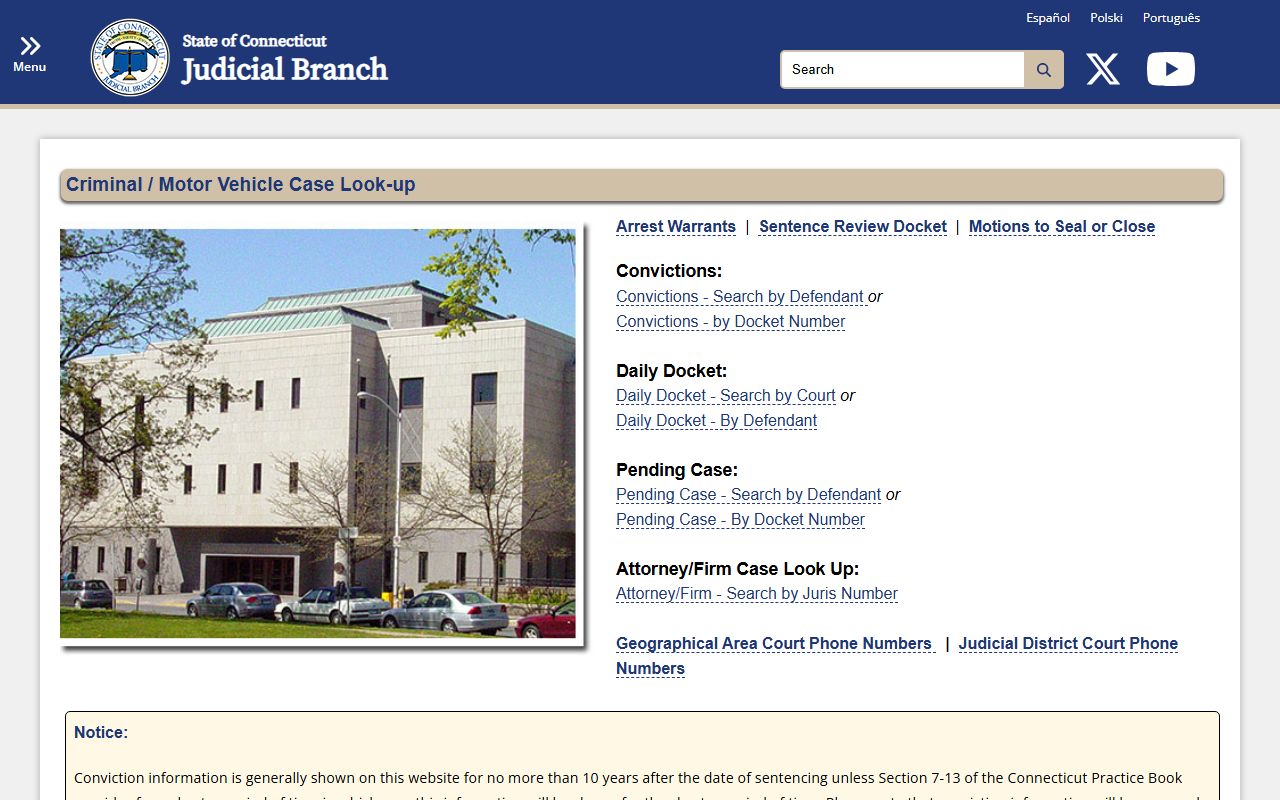
This landing page is the front door for finding the charges a State's Attorney filed once a New Britain arrest moves into court.
- Open the Judicial Branch criminal lookup and start a defendant-name search.
- Narrow the results by court location or docket number when the portal allows it.
- Match the arrest date and the arresting police department to the right case.
- Compare the booking charges to the charges the court record shows.
- Contact the court clerk for older or nonpublic files.
A single arrest can generate more than one docket or charge, so read each case event carefully. For older files, the clerk may hold records the online portal does not display. Juvenile matters do not run through ordinary adult channels, and they are not open to the public.
Connecticut Court Lookup Search Fields
The Judicial Branch defendant search uses a small set of fields to find a case. The exact labels and dynamic behavior were not fully confirmed during research, because the form changes and should be checked live. The table below lists the known search paths honestly, with that caveat. Treat the field names as a guide, not as fixed labels.
The Connecticut Judicial Branch hosts the criminal defendant search form that runs these queries. The screenshot below shows where a name or docket search begins.
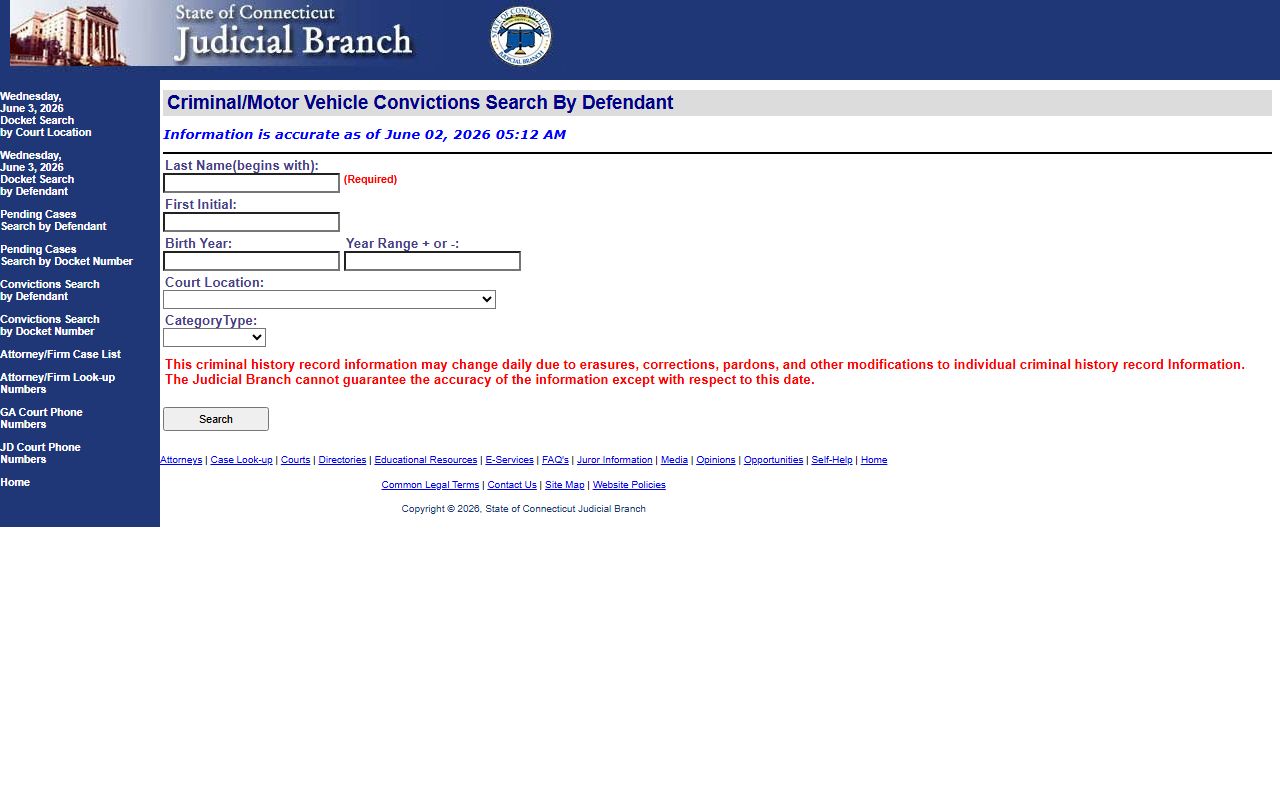
This form is the tool to pull a filed case after an arrest, once the State's Attorney has charged it.
| Field | Type | Notes |
|---|---|---|
| Defendant name | Text | Primary search path; dynamic form should be checked in a browser. |
| Docket number | Text | Use the exact docket if you have it. Status not fully confirmed. |
| Court location / case type | Dropdown | New Britain Judicial District or GA 15 may apply; options not captured. |
| Date of birth | Text or date | Some court searches use a birth date to narrow results; not confirmed. |
| Search / Submit | Button | Exact button label not captured. |
Police Booking Charges vs Filed Court Charges
The charge on the booking sheet is not always the charge in the court file. New Britain Police list a charge at the time of arrest. Then a State's Attorney reviews the police report and the evidence. The prosecutor can amend a charge, substitute one charge for another, reduce it, add a count, nolle it, or dismiss it outright. Whatever the prosecutor files is what the court record carries forward. That is why the court file controls. Two people can read very different things from the same arrest if one looks only at the booking charge and the other reads the filed case.
This split matters most when someone tries to judge an arrest from early data alone. The booking charge can sound severe and later be reduced. It can also be one charge at booking and three charges once filed. The court record is the place to confirm what is real and current.
| Police booking charge | Filed court charge | |
|---|---|---|
| Who creates it | New Britain Police at arrest | State's Attorney after review |
| Where it appears | Police report / booking record | Judicial Branch case record |
| Can it change? | Yes, before charges are filed | Yes, by amendment, nolle, or dismissal |
Charge Status in New Britain Court Records
Each charge in a court record carries a status. The status tells you whether the charge is live, changed, or stopped. New Britain booking charges can differ from these final court terms, so always read the status on the case itself. A few words come up often, and one of them, nolle prosequi, throws people off. It simply means the prosecutor has decided not to go forward on that charge for now.
| Status | What It Means |
|---|---|
| Pending | The charge is open and unresolved. The case is still moving through court. |
| Amended / Reduced | The original booking charge was changed or lowered to a different charge. |
| Dismissed | The court ended the charge with no conviction. It is over. |
| Nolle Prosequi | The prosecutor declined to go forward on the charge. In plain words, they dropped it for now. |
Note: A dismissed or nolled charge may later qualify for erasure under Connecticut law, which can change what stays public.
The State's Attorney and New Britain Court Records
Connecticut does not use the title district attorney. The prosecutor here is a State's Attorney, and the statewide agency is the Connecticut Division of Criminal Justice. For New Britain felony-level matters, the prosecutor is the Hartford Judicial District State's Attorney. The phrase district attorney shows up only as a search term people type out of habit. The office that actually shapes the court record is the State's Attorney.
The role is direct. The State's Attorney reviews the arrest and the police report. The office files, substitutes, amends, dismisses, or nolles charges. It represents the state in court. It coordinates with the courts, victims, police, and custody officials when needed. Because the prosecutor makes the charging call, the filed court record reflects the prosecutor's decisions, not just the arresting officer's first list of charges.
Note: Office addresses and phone numbers change, so the official Division of Criminal Justice page is the safest place to confirm current contact details.
Bond and Release After a New Britain Arrest
Connecticut handles release through the courts, not a county bond window. After an arrest, New Britain Police may release a person on a promise to appear, which is a written pledge to show up in court. In other cases, the person is held until arraignment. Arraignment is the early court appearance where charges and release terms are addressed. A judge can set, lower, or review bond at that hearing or later. If the court remands the person, the custody facility is usually Hartford Correctional Center, which serves New Britain courts. Connecticut's bail and pretrial rules sit in Chapter 961a of the General Statutes.
Several release paths can appear in the court record. A surety bond is one many people ask about. It means a licensed bail bond agent posts the bond on the defendant's behalf. A hold, also called a detainer, is another. Even when a New Britain case bond is posted, a separate warrant, a probation hold, or an immigration detainer can keep a person in custody. Read the case carefully to see if a hold applies.
| Bond Type | How It Works |
|---|---|
| Cash Bond | Money paid directly to satisfy the set bail amount. |
| Surety Bond | A licensed bail bond agent posts the bond for the defendant. |
| Promise to Appear | Release on a written pledge to return to court, with no money posted. |
| No-Bond Hold | Release by money is blocked until a court order or a hold clears. |
No New Britain online bond-payment portal or facility fee table was found in official sources. So do not rely on a posted percentage or payment method from an unofficial site. Use the court paperwork and the case record to read the bond amount, then call the court clerk before you travel to confirm the conditions.
New Britain Warrants That Lead to an Arrest
Many arrests start with a warrant. A warrant is a court order that allows police to act. New Britain has no official active-warrant roster, and Connecticut warrant information is spread across police, court, and state systems. So the check is not a single public list. The court docket and the court clerk are the most reliable place to see whether a warrant is part of a case. A bench warrant or a failure-to-appear can show in the docket when the data is public.
| Warrant Type | What It Means |
|---|---|
| Arrest warrant | Court authorization to arrest based on probable cause. |
| Bench warrant / failure to appear | Issued by a judge when a person misses court or breaks a court order. |
| Search warrant | Authorizes a search of a place or property. It is not an inmate record. |
| Fugitive hold | Another jurisdiction wants the person held. |
No statewide public warrant search like a sheriff's wanted list was located for Connecticut. Anyone who believes they have a warrant should speak with an attorney or the court before walking into a police station. The Judicial Branch case lookup and the clerk remain the practical check.
Charges vs Convictions in Court Records
An arrest and a charge are not a conviction. This is one of the most misread parts of any court record. A charge is an accusation. It opens the case. A conviction comes only after a plea or a verdict. Many charges never become convictions. They get reduced, dismissed, or nolled along the way. Reading a court record well means telling these two stages apart.
| Charge | Conviction | |
|---|---|---|
| Stage | An accusation that opens the case | A guilty plea or a verdict |
| Proof needed | Probable cause to arrest and charge | Proof beyond a reasonable doubt |
| What the record shows | Pending, amended, dismissed, or nolled | A final guilty outcome and sentence |
Sealed and Erased Records in Connecticut
Connecticut does not use the words sealed and expunged the way many states do. The state uses erasure. Under Connecticut General Statutes Section 54-142a, certain criminal records are erased after a dismissal, an acquittal, a nolle that ripens, a pardon, or another qualifying outcome. Erasure is stronger than hiding a record. It treats the record as legally erased. That is why the comparison below frames it as erased versus still public, not sealed versus expunged.
| Erased record | Still public record | |
|---|---|---|
| Legal status | Erased under Section 54-142a | Open in the court file |
| What triggers it | Dismissal, acquittal, nolle, or pardon | Pending or convicted charges that do not qualify |
| Public access | Removed from public disclosure | Viewable in the case lookup |
Juvenile matters sit in their own category. They are confidential. Juvenile cases do not run through the adult court lookup, and police cannot release juvenile arrest information. So a missing public record does not always mean nothing happened. It can mean the record qualified for erasure or that the matter is a confidential juvenile case.
Restricted Court Records After a New Britain Arrest
Not every court record after an arrest is open to the public. Connecticut law carves out several limits. Juvenile cases are confidential, and New Britain Police are forbidden by statute from releasing juvenile arrest information. Erased records under Section 54-142a drop out of public view once a case ends in a qualifying way. Some files have statutory exemptions that block disclosure. When the online lookup shows nothing, the cause can be a restriction, not a clean history.
For records that are not online, the route runs through the court clerk for case files, and through the police records process for releasable arrest information. The Connecticut public-records access statute and the arrest-record disclosure statute set the broad right of access along with its limits. The right is wide, but statutory exemptions and the juvenile boundary still apply.
Note: A blank result in the court lookup may reflect a juvenile case, an erased record, or a statutory exemption rather than the absence of any arrest.
Background Check Considerations
Court records and casual lookups are not the same as an official background check. For a formal criminal-history check in Connecticut, the source is the Connecticut State Police Bureau of Identification. That office holds the official criminal history record. A name search in the court lookup can confirm a single case, but it is not a full, certified history. Anyone who needs a record for a formal purpose should use the official channel and confirm the result with the office that created it.
Important: This is not a consumer reporting agency under the FCRA, and nothing here may be used for credit, employment, tenant, or insurance decisions.